Enabling a torque tool at the correct station
A cordless nutrunner used at the next station can attach a valid torque result to the wrong assembly.
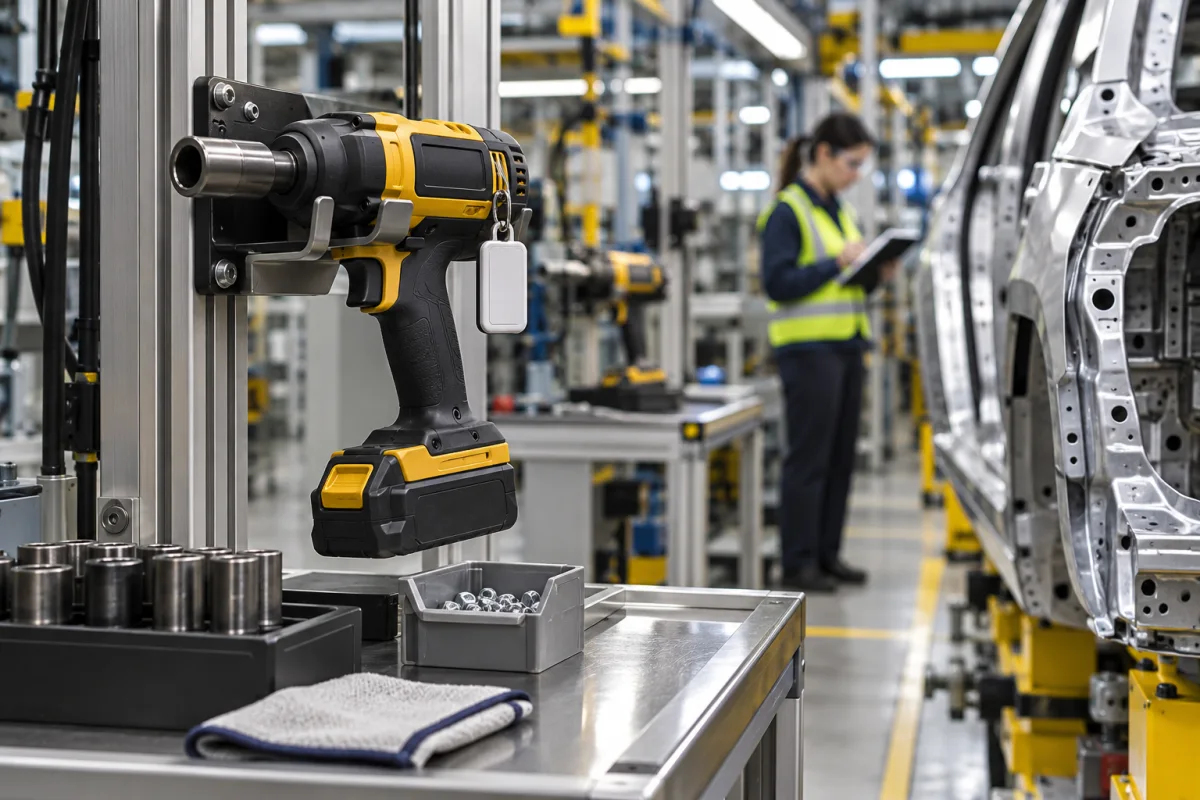
- 1Work order assigned to station B.
- 2Station A · Trigger pressed, socket stationary.
- 3The operator carries the same tool to station B.
- 4UWB confirms the station. The tool runs.
- 5Bolt fully seated.
How UWB helps
UWB locates the tool by station. The line application can check the active work order before enabling the tightening controller. Quality engineers can review the result against tool, station and product identity.
Where does the defect start?
Dozens of torque tools on an assembly line look alike. At shift change, after maintenance or in a busy moment, a tool drifts to the next station. A tightening done with a tool set to a different torque goes unnoticed.
The defect surfaces at quality control, or worse, in the field. Tracing which tool was used where is often impossible.
How it works
- 1
A tag goes on the tool
A small UWB tag is fitted to each torque tool; the mounting method is chosen for your tool models.
- 2
Anchors cover the line
Anchors on ceilings and columns measure each tool’s position with 10–30 cm accuracy.
- 3
Stations are drawn
Each station boundary is defined in software and paired with its tool. Redraw them when the line changes.
- 4
The lock decision
Inside its station the tool is released. Outside, a lock signal goes to the tool controller.
What changes on site
Stopped before it’s a defect
A tool at the wrong station cannot tighten; the problem never reaches quality control.
Every tightening has a location
Which tool was used at which station is recorded and traceable.
No more tool hunts
A misplaced or missing tool shows up on the map instantly.
Works with your existing systems
UltraPulse doesn’t replace your systems; it adds location to them.
- Tool controllersLock and release signals go to the tool control system.
- Line and production softwareTightening locations and events flow into your manufacturing systems.
- More scenarios, same infrastructureThe same anchors also track people and equipment.
FAQ
Can it be fitted to our existing torque tools?
Yes. The mounting method is chosen for your tool models during the site survey.
Is the accuracy enough to separate adjacent stations?
UWB measures to 10–30 cm. Station boundaries are drawn with that in mind, with a safety margin between them.
Do we need to stop the line to install?
Anchor placement and the installation schedule are planned with you around how your line runs.